
Event Räume zwischen Vergangenheit und Gegenwart - Lauchhammer, Exhibition
Section Biennale
Duration 08 Aug — 23 Aug 2026
Info Thursday-Sunday, 11:00 a.m. – 6:00 p.m.
Location Heinrich-Zille-Str. 1 Lauchhammer, District Oberspreewald-Lausitz
Lauchhammer Neustadt 1 is characterized by long rows of apartment buildings dating from the prosperous era of the 1950s and 1960s in the former GDR, many of whose windows now stand empty. Once designed as a residential area for workers in the surrounding industrial sector, this part of Lauchhammer embodied a spirit of renewal, security of supply, and a promise of stability and the future.
However, with the decline of industry and the end of lignite mining, the neighborhood lost its economic and social foundation. Apartments were abandoned, entire rows of houses were boarded up, and infrastructure gradually disappeared. What remained was a fragmented urban landscape in which the past and present overlap.
Amid the remaining residents, vacant lots, and the first signs of new uses, structural change is evident here on a small scale. Lauchhammer Neustadt 1 exemplifies the question of how places can continue to exist when their original function is lost, and what new meanings emerge in the resulting voids.
For the Lausitz Biennale, one of the vacant apartment blocks will be reopened for the first time and transformed into a temporary art space. Here, questions of loss, memory, and the future are reexamined.
Artistic Positions
Christian Hasucha’s work “m i t t l e r w e i l e” adorns the approximately 50-meter-long facade of a vacant building. Taking as his starting point windows that have been bricked up and sealed with wooden panels, Hasucha engages with the existing visual patchwork and supplements it with twelve additional panels on the first floor. These feature oversized letters that together form the word “mittlerweile.” In the evening and at night, the letters become visible through light projections. As they alternately appear and disappear, “Mittlerweile” can be experienced as a state of transition.
Claudia Pilsl uses a participatory photographic technique known as camera-less photography. in which plants are imaged directly onto light-sensitive material. Together with residents, she collects native plants during walks through the neighborhood; in one of the vacant apartments, Pilsl teaches the photographic technique and creates a space for collaborative artistic work.
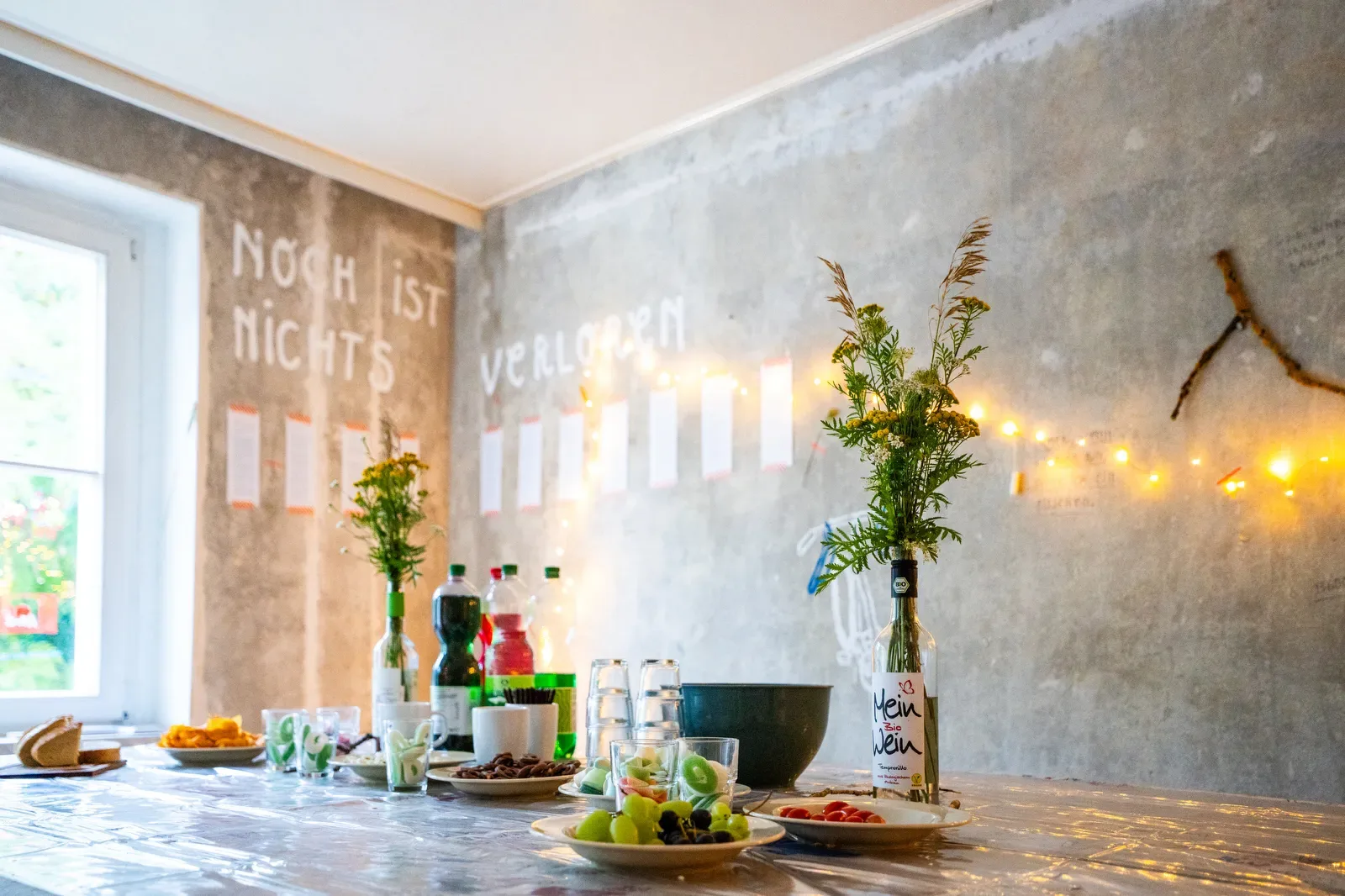
The artist duo Matrosenhunde presents “Nothing Is Lost Yet”, an interactive installation that transforms the building at Zillestraße 1 into a walk-in book. Large-format fabric panels hanging from windows and balconies feature drawings and text fragments from conversations with residents. Personal memories, everyday observations, and historical traces intertwine to form a multi-layered narrative. A QR code leads to expanded texts and a digital map of the locations where the conversations took place.
Anke Hannemann’s installation “VERITAS” combines a modified sewing machine from VEB Nähmaschinen Wittenberge with a historic wedding photograph of her great-grandparents in Sorbian traditional dress. The machine sews ceaselessly in reverse with a gold-plated needle—a process that produces no product but rather negates itself. This movement becomes a symbol of the attempt to preserve the past without actually being able to bring it back.
The participatory project “Spurlos verschwunden” by Frida Teller and Marie Kublik explores the visibility of female poets in the GDR and today. In workshops, texts by female authors from the GDR enter into dialogue with contemporary voices. Three writing workshops are complemented by two embroidery workshops, in which verses and personal statements are transferred onto fabric.
At the center of Anja Nürnberg’s large-format charcoal drawings “Ikarus 280.3 – Voices of Lower Lusatia” is the Ikarus 280.3 articulated bus—once a defining element of everyday life in the GDR. The works condense memories of crowded bus rides, the smell of diesel and coal dust, and social dynamics (“Schlenki” and “Schlipsbus”) into an atmospheric visual space.
Louisa Frauenheim is developing a sound-floor installation in a former bus stop waiting area. Several megaphones intermittently produce the roar of jackhammers, followed by periods of absolute silence. This rhythmic sequence becomes a physical experience and points to tensions between labor and destruction, progress and overwhelming demands.
Through intensive research and the compilation of curated artifacts, a space emerges that reflects on the past and present while simultaneously opening up future scenarios that can be experienced through biotechnological processes. The installation combines Sorbian folklore, GDR ephemera, historical objects, and laboratory elements into a hybrid experiential space in which the boundaries between fact and fiction are deliberately blurred. The result is Bernhard Schipper’s Sorbian Futurism.
The video work “Letzte Kumpel” by Johannes Weilandt portrays four former miners from the Mansfeld region and their perspectives on a vanished world of work. The focus is on memories of physical labor, camaraderie, and the loss of a system that defined their identity. Today, the protagonists meet at a shooting club—a new social space in post-industrial daily life.
An accompanying discussion format invites the audience to engage directly with the themes.
Artists
Louisa Frauenheim
Louisa Frauenheim (born in 1990 in Hamburg, Germany) is a visual artist who lives and works in Berlin. She studied fine arts at the Berlin University of the Arts from 2016 to 2022, where she graduated with honors and was named a master student of …
more about Louisa FrauenheimJohannes Weilandt
Johannes Weilandt (born 1991) lives and works as a visual artist in Berlin. He studied fine art and stage and costume design at the Weißensee Academy of Art in Berlin and at the University of Arts in Belgrade, and was awarded the title of …
more about Johannes WeilandtClaudia Pilsl
Claudia Pilsl (born 1965 in Wels, Austria) is an artist and scholar specializing in photography and film. She studied at the University of Applied Arts Vienna and the Berlin University of the Arts. From 2011 to 2013, she completed the master’s …
more about Claudia PilslChristian Hasucha
Christian Hasucha (born in 1955 in West Berlin, West Germany) is a visual artist based in Berlin. He studied fine arts at the Berlin University of the Arts and at the Chelsea School of Art in London.
more about Christian HasuchaMatrosenhunde
Sailors' dogs seek out and find things, weaving their experiences together with their own subjective thoughts, feelings, and memories.
more about MatrosenhundeAnke Hannemann
Anke Hannemann (born in 1980 in Cottbus, GDR) is a mixed-media artist and lecturer. She studied English literature and art history at the Technical University of Dresden, fine arts at the Bauhaus University Weimar, and sound and performance art at …
more about Anke HannemannMarie Kublik & Frida Teller
Marie Kublik and Frida Teller are members of the same poetry group in Leipzig.
more about Marie Kublik & Frida TellerAnja Nürnberg
Anja Nürnberg (*1982 in Magdeburg) ist bildende Künstlerin und lebt und arbeitet seit 2008 in Halle (Saale). Nach einem Studium der Internationalen Betriebswirtschaft in Deutschland und den USA absolvierte sie von 2008 bis 2013 ein Studium der …
more about Anja NürnbergBernhard Schipper
Bernhard Schipper (*1970 in Bautzen/DDR) ist Medienkünstler und Materialwissenschaftler. Er studierte Bildende Kunst mit Schwerpunkt Medienkunst/Intermedia an der Hochschule für Grafik und Buchkunst Leipzig bei Prof. Alba D’Urbano und schloss sein …
more about Bernhard Schipper