
Event Urbane Wandlungen. Kunst zwischen Bewegung, Erinnerung und Transformation, Exhibition
Section Biennale
Duration 05 Sep — 20 Sep 2026
Info Thursday through Sunday, 11:00 a.m. – 6:00 p.m. (Closed Monday through Wednesday)
Location Kunsthalle Lausitz, District Stadt Cottbus
For its final exhibition stop, the 1st openart Lausitz Biennale 2026 will be held at a location that is itself a symbol of change, movement, and transformation: the historic Großenhain Train Station in Cottbus.
The imposing train station building was constructed in 1877–78 and lost its original function after the new Cottbus State Station was built. Starting in 1885, it served as an administrative facility and later as a freight yard. Renovated and converted into an office building after German reunification, it later became home to the Kunsthalle Lausitz. Since 2019, it has been a central venue for contemporary art from the region. As part of the Lausitz Biennale, artistic works from the fields of media art, sculpture, comics, graffiti, and street art are presented here.
In the Gray Vestibule, the artist duo URBAN ART—Anne Peschken and Marek Pisarsky—explores the global shift of textile production from Europe to Asia. The starting point for their work is the once-prosperous textile industry in Cottbus. To this end, they have erected a large loom on which painted and discarded canvases are woven into new pictorial surfaces. An accompanying monitor documents the creative process in the studio. In addition, the Green Hall features a monumental woven work nearly 3.50 meters wide depicting seamstresses from Asia.
On the opposite side of the vestibule, Caroline Böttcher presents a multimedia installation featuring textile objects, photographs, and narrative fragments on the history of the Lusatian textile industry. Her work explores the ambivalence between beauty, sensuality, and industrial production, focusing in particular on the role of women in the textile industry as well as on structural change in East Germany.
With her work verwoben, Annette Hecht-Bauer addresses the themes of environmental pollution and loss. The dress, woven from plastic waste, highlights the possibilities of an experimental approach to used materials and everyday objects.
The Cottbus-born artist Felix Matschke presents a series of digitally drawn illustrations titled Heute Hier, Morgen Fort (Here Today, Gone Tomorrow). Now living in Switzerland, his works depict the changing architecture of Lusatia and other places, against which shadowy figures appear. Through red-and-green overlays and shifting LED light installations, dynamic spaces of perception emerge, hovering between memory and dissolution.
Along the path through the building, visitors can view the Sorbian Mangas by the artist Siggiko (Emily Barthold). She combines Sorbian legends, traditions, and Lower Sorbian culture with the visual language of Japanese manga, thereby creating a contemporary visual form of expression for a young generation of Sorbian identity.
Valentina Troendle presents her photographic Lusatia series Sediment. Her works approach Lusatia as a poetic in-between space—a landscape in transition between the past and the future. The photographs quietly tell stories of places, people, and atmospheres, allowing viewers to experience the region as a living, breathing space.
Through humorous drawings, Lioba von den Driesch addresses universal human conflicts—such as community, conflict, betrayal, and discord—in her animated film Last Supper. The figures, drawn with chalk on blackboards, straddle the line between comics and animation.
The Green Hall is dedicated to contemporary social issues. In her four-meter-long painting How to Dress for Jogging, which draws inspiration from street art, Katharina Arndt humorously questions the superficiality of modern consumer and lifestyle culture.
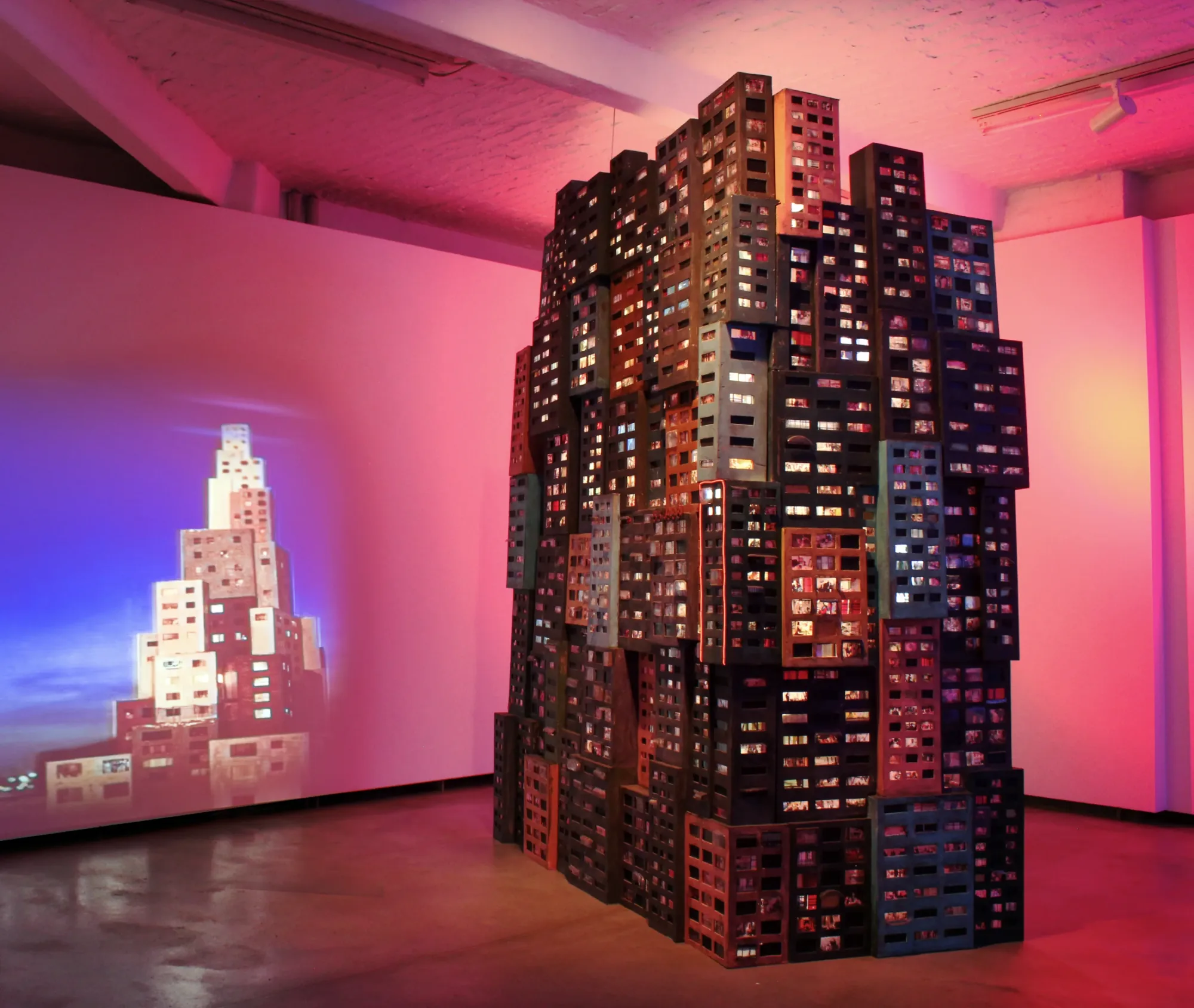
Opposite it stands the sculpture Tenement Rising by American artist Tracey Snelling. Featuring integrated video sequences about cramped living conditions, it addresses rising housing costs and social displacement. In light of global developments, the work raises the pressing question: Where are we headed?
Positioned between these works is Dredder, a sculpture by Martin Böttger. The brightly colored metal fragments are reminiscent of futuristic mechanical beings and serve as a connecting element between street art, urbanity, and social exaggeration.
With his painting Social Silence, Casey McKee depicts a surreal beach scene set against the backdrop of an oil rig. With humor and a critical eye, the work reflects on social power structures, environmental issues, and the consequences of human intervention in landscapes—including the transformation of former lignite-mining regions in Lusatia.
Finally, at the center of the Green Hall stands the monumental sculpture Fragile Wucht by Miriam Lenk. The baroque-inspired figure of a female archetype moves between strength and vulnerability, order and chaos, decay and new beginnings. Through this work, the artist creates a powerful image of female self-empowerment and social transformation.
The closing exhibition of the openart Lausitz Biennale 2026 connects history and the present, regional memory and global developments. The historic Großenhain train station itself becomes a resonant space for art that transforms spaces and makes social processes visible.
Outside the former Großenhainer Bahnhofs, a graffiti session featuring local and international graffiti artists will take place on the platforms and tracks during the exhibition period.
Accompanying this, workshops for children and teenagers will be offered, providing direct insight into the techniques, history, and forms of expression of graffiti art. The grounds of the former freight station have been an established venue for graffiti and urban art events for several years now. Building on the site’s long-standing, successful graffiti culture, the openart Lausitz Biennale 2026 will integrate the theme of urban and street art into the exhibition held within the historic train station building—now the Kunsthalle Lausitz. In doing so, the biennial connects contemporary urban culture with the site’s historic architecture and fosters a vibrant exchange between art, urban history, and public space.
Artists
Anne Peschken / Marek Pisarsky (Urban Art)
Anne Peschken (born in 1966 in Montreal, Canada) and Marek Pisarsky (born in 1956 in Ruda Śląska, Poland) have been working together as an artist couple under the name Urban Art since 1988.
more about Anne Peschken / Marek Pisarsky (Urban Art)Annette Hecht-Bauer
Annette Hecht-Bauer (born in 1963 in Reutlingen) is a freelance artist, designer, and instructor specializing in textiles, objects, and printmaking. She lives and works in Baden-Württemberg.
more about Annette Hecht-BauerCaroline Böttcher
Caroline Böttcher (b. 1985) lives in Berlin; she is an artist and author who works at the intersection of photography, site-specific sound art, and research on the culture of memory. She studied photography at the Academy of Visual Arts in Leipzig …
more about Caroline BöttcherCasey McKee
Casey McKee (born in 1976 in Phoenix, Arizona, USA) is an American painter living in Germany.
more about Casey McKeeKatharina Arndt
Katharina Arndt (*1981 in Oschatz) lebt und arbeitet in Berlin und Barcelona. Sie studierte Bildende Kunst an der Hochschule für Bildende Künste Braunschweig und schloss ihr Studium mit dem Master of Fine Arts bei John Armleder ab.
more about Katharina ArndtLioba von den Driesch
Lioba von den Driesch (*1957 in Mainz) arbeitet seit Mitte der 1990er-Jahre im Bereich Animation, Illustration, digitale Medien und Vermittlung. Nach dem Ersten Staatsexamen in Kunsterziehung an der Johannes Gutenberg-Universität Mainz und dem …
more about Lioba von den DrieschMiriam Lenk
Miriam Lenk (*1975 in Konstanz/BRD) ist eine deutsche Bildhauerin. Nach Abitur in der Klosterschule und einer Ausbildung als Goldschmiedin studierte sie Literatur und Medienwissenschaften, später Kunst in Dresden mit einem Stipendium in Barcelona.
more about Miriam LenkSiggiko
Emily Barthold alias Siggiko (* geboren in Washington, D.C./USA) ist Comic-Künstlerin, Librettistin und Literaturwissenschaftlerin. Sie studierte Germanistik und Internationale Beziehungen an der George Washington University und absolvierte …
more about SiggikoValentina Troendle
Valentina Troendle (*1991 in Augsburg) lebt und arbeitet in Berlin und in der Lausitz. Sie absolvierte einen Bachelor of Arts in Kulturarbeit und einen Master of Arts in Urbaner Zukunft/Transformationsmanagement an der Fachhochschule Potsdam, …
more about Valentina TroendleTracey Snelling
Tracey Snelling (*1970, Oakland, Kalifornien) ist eine bildende Künstlerin, deren Arbeit untersucht, wie Architektur die Art und Weise prägt, wie Menschen leben. Seit 2016 lebt und arbeitet sie in Berlin. In den Medien Skulptur, Installation, Video, …
more about Tracey SnellingFelix Matschke
Felix Matschke (*1989 in Cottbus) ist ausgebildeter Architekt und seit 2024 freischaffender Illustrator mit Sitz in Zürich. Nach einem Architekturstudium an der BTU Cottbus und der Technischen Universität München war er mehrere Jahre in …
more about Felix MatschkeEndstation Jam
Zur Endstation Jam entsteht rund um den nördlichen Bahnhofsausgang eine großflächige Open-Air-Galerie. Zahlreiche Wände des Bahnareals dürfen im Rahmen des Festivals künstlerisch gestaltet werden; insgesamt stehen dafür rund 1.600 Quadratmeter …
more about Endstation JamMartin Böttger
In his work, Martin Böttger explores human evolution as an abstract investigation of the body and its optimization, as well as its position within the age of information, neuroscience, and biotechnology. The body and its appearance are in a constant …
more about Martin Böttger